


Ask the Experts
Viance began over 30 years ago to develop advanced building material solutions that improve the performance and durability of wood products. Our expertise in biocides and wood protection chemicals has changed the industry in providing preservatives that have a lower impact on our environment.
See recent questions we are asked with answers below. Check out our full FAQ's from preservatives to deck care. Use the form below for any questions or email us at customerservice@viance.com.
We look forward to being of help. Thank you for contacting Viance.
Ask our Experts
Cleaning and Staining Treated Wood
Open All
-
What do I use to clean my treated wood deck?
- Clean annually and keep your deck free from dirt and debris.
- A solution of liquid detergent and water with a stiff brush will remove mildew and dirt.
- For hard to clean surfaces, use a deck brightener containing oxalic acid to retain the wood’s natural beauty.
- Never use household chloride bleaches or foaming cleaners as they can strip the preservatives and damage the wood fibers leaving an unnatural whitewashed appearance.
- Be careful if using a pressure-washer as excessive pressure may cause damage to the wood.
-
How do I remove the grade stamp on my treated wood deck?
Light sanding will remove or lighten the grade stamp's appearance.
-
How long do I need to wait to stain or paint my treated wood deck?
- Allow treated wood to dry prior to application. Test the wood with a few drops of water to see if the wood is dry enough to readily absorb water.
- Typically, treated wood will be dry and ready for finishing 60 days after installation.
- Apply the stain to a small portion of the deck to ensure the wood is sufficiently dry.
- Follow the manufacturer's instructions.
-
What do you recommend I use to stain or paint my treated wood deck or fence?
- Use a good quality oil-based or water-based stain, or exterior wood water sealant product with UV protection to help prevent the wood from turning gray from exposure to the sun.
- Apply a water repellent sealer at least every two years.
- Follow the manufacturer's instructions.
-
How do I remove mold from my deck?
Mold that you find on pressure treated wood is not an indication of a fungal attack. Mold can grow on the surface of many products including wood (treated and untreated) due to exposure to moisture. To remove mold from your treated deck, use mild soap and water solution and a stiff brush.
Mold Growth
Mold and mildew are present everywhere in our environment, both indoors and outdoors. Mold and mildew need four things to thrive: air, water, temperatures between 32 and 120°F, and a food source, conditions that are common wherever humans live, work, and play.
The best way to minimize mold and mildew growth is to control water and food sources. When it comes to mold or mildew on wood decking, water and organic matter are the primary conditions that enable mold and mildew colonies to thrive. To minimize these conditions, make sure water has the ability to flow away from the deck surface and areas surrounding the deck to lessen the absorption of water. Ensure there is adequate ventilation between deck boards and underneath the deck surface, so water can rapidly evaporate.
And since both mold and mildew feed on dead or decaying organic matter, so it is important to keep your deck clean of leaves and debris.
Cleaning Your Deck
To minimize mold on your decking, clean your deck as often as needed, at least twice each year. Climate conditions vary in different regions of the country and may necessitate more periodic cleaning.
Remove leaves, debris, and other organic materials that provide a food source for mold.
If mold is present, there are many commercial products available for cleaning mold. We recommend commercial cleaners containing oxalic acid. For best results, follow the manufacturer’s instructions and use cleaners within their stated shelf life. Do not mix recommended cleaning products together as harmful chemical reactions could occur.
We do not recommend household chloride bleaches or foaming cleaners as they can strip the preservatives and damage the wood fibers leaving an unnatural whitewashed appearance.
To maximize application coverage, remove excessive organic growth or clumps prior to applying the cleaner.
Coatings for High Mold-Prone Environments
For environments prone to high mold growth, there are commercially available coatings and finishes that seal the wood surface when applied and they should be maintained per the manufacturer’s instructions.
- Coatings should be applied within one week of cleaning for best results.
- Prior to coating, properly clean the decking, rinse thoroughly with water and allow to dry completely.
- Sweep off any pollen and debris.
Tips for Minimizing Mold
- Maintain a deck that is dry and clean.
- Ensure gutters / down-spouts and dryer vents do not discharge directly on decks.
- Ensure adequate ventilation under and between decking boards.
- Minimize water puddles under decks and the use of wet mulch up against the deck structure.
- Cleaning a deck just after the last of the major pollen events (when your car doesn't change color from the pollen anymore) will minimize the seasonal outbreak of mold and mildew.
- Periodically rinse off your deck using a garden hose with a spray nozzle, especially after the major pollen events. Skilled professionals may use pressure washers with wide fan tips but in the wrong hands, your deck can be damaged. Exercise extreme caution when using pressure washers.
- Ensure the gaps between the decking boards remain free of debris so that regular rain showers can remove pollen and organic debris between cleanings.
- Avoid fertilizer over-spray.

Installation
Open All
-
Do I need to treat the cut ends on my fence posts?
I just got a fence installed with ground contact pressure treated 4x4 posts. I think it is your Preserve. Do I need to treat the cut ends of the posts? They look to be green all the way through but I wanted to be sure.
Construction projects necessitate the need to cut and drill into wood. Building codes and the American Wood Protection Association (AWPA) Standard M4-15 require "all cuts, holes and injuries such as abrasions or holes from removal of nails and spikes which may penetrate the treated zone shall be field treated." The extra effort protects the longevity that the preservatives offer.
Copper naphthenate is one of the most used preservatives for cut ends and holes. The minimum recommendation is 2% copper metal with 1% copper naphthenate appropriate in those regions of the country where the higher concentration material is not readily available.

Photo courtesy of preservedwood.org Another two preservatives, oxine copper and inorganic boron can be used for field treating in above ground applications. Oxine copper can be used for applications originally treated with oil-borne or waterborne preservatives. Oxine copper preservatives, containing the recommended minimum .675% oxine copper (0.12% copper metal), are available colorless or in various colors and have little odor, according to preservedwood.org. Inorganic boron can be used in applications originally treated with a waterborne treatment and in areas continuously protected from liquid water.
These topical preservatives are available in the retail market and can be purchased at local home centers, building material retailers and paint stores who stock products for wood decks or ordered online. Be sure to follow the preservative’s manufacturer's application instructions.
Jonathan Whitehead, Eastern Region Sales
704-493-0023
jwhitehead@viance.net
Check out Jonathan's bio here.

-
Can treated wood be used for sill plates and interior applications?
Treated wood is intended for exterior use. However, all treated wood material for residential use can be used for indoor, outdoor or in play set construction.
Example: If the Ecolife product is going to be used 6” above the final grade and will be on a wood subfloor as a sill plate for the stud walls, then EcoLife treated wood is okay to use. Please read the Ecolife installation instructions and adhere to all fastener requirements.

Example: If the Ecolife treated lumber is going to be used on a concrete slab, then a foam sill seal must be used as a barrier between the concrete and the EcoLife treated wood. We recommend that Dow’s Sill Seal be used to provide this moisture protection. Please adhere to all of Dow’s installation instructions on proper installation. The installation instructions can be found on the product or on data sheets at your local Lowe's retailer. Be sure that the concrete building surface will be above the final grade and all water is diverted away from the slab. If you have any further question please let me know. Thank you again for your inquiry and happy building.
Jonathan Whitehead, Eastern Region Sales
704-493-0023
jwhitehead@viance.net
Check out Jonathan's bio here.
Ecolife® Stabilized Treated Wood
Open All
-
What are the benefits of Ecolife®/Severe Weather® treated lumber compared to other wood treatments?
- The built-in wood stabilizer keeps boards straighter and minimizes cracking, checking and splitting.
- An environmentally advanced, non-metallic preservative, Ecolife (EL2) is extremely effective at .019 pcf retention, a fraction of competing products that use two times the chemicals to achieve adequate above ground product performance.
- The water repellent stabilizer is a built-in part of the preservative system and not an add-on that can vary by treater supplier.
- Fights exposure to the sun and rain and is used in building decks, railings, fence pickets, arbors, trellises, joists and beams.
- Less corrosive to connectors and fasteners and can be used in direct contact with aluminum products, even in continuously wet applications.
- Unsurpassed in effectiveness with virtually no warranty claims in its history.
- Designed for above ground applications six inches or more off the ground.
Edie Kello, Director of Marketing
704-905-4726
-
Can treated wood be used for sill plates and interior applications?
Treated wood is intended for exterior use. However, all treated wood material for residential use can be used for indoor, outdoor or in play set construction.
Example: If the Ecolife product is going to be used 6” above the final grade and will be on a wood subfloor as a sill plate for the stud walls, then EcoLife treated wood is okay to use. Please read the Ecolife installation instructions and adhere to all fastener requirements.
Example: If the Ecolife treated lumber is going to be used on a concrete slab, then a foam sill seal must be used as a barrier between the concrete and the EcoLife treated wood. We recommend that Dow’s Sill Seal be used to provide this moisture protection. Please adhere to all of Dow’s installation instructions on proper installation. The installation instructions can be found on the product or on data sheets at your local Lowe's retailer. Be sure that the concrete building surface will be above the final grade and all water is diverted away from the slab. If you have any further question please let me know. Thank you again for your inquiry and happy building.
Jonathan Whitehead, Eastern Region Sales
704-493-0023
jwhitehead@viance.net
Check out Jonathan's bio here.

-
Can a fire retardant be added to Ecolife and still be effective?
The Ecolife treatment does not impart fire retardancy properties to decking.

Unfortunately there isn’t a treatment on the market for both durability and fire retardancy.
A fire retardant coating will likely wear off over time because it is not pressure impregnated. In addition, building codes do not recognize sprayed-on or brushed-on coatings as code approved fire retardants for wood products; they only recognize formulations that are vacuum/pressure impregnated products.
Most pressure treated fire retardants are for interior use only, i.e. our D-Blaze fire retardant treated wood product. However, there are some exterior fire retardants available but they don’t increase the weathering, durability, or insect/fungal protection of wood so they are usually only used on naturally durable species of decking like Redwood and Western Red Cedar. The availability is somewhat limited so you would have to check with your local retailer on availability.
Thank you,
Todd Schoffstoll, Western Regional Manager
704-340-3376
tschoffstoll@viance.net

-
Can treated wood be used on aluminum boats?
Question
I am going to use Ecolife treated plywood for my jon boat floor since it is safe for aluminum contact. The floor will be attached to braces that are 14" on center so it will be 2" off the bottom of the floor so it will have air under it. My question is painting...should I paint the plywood on both sides or paint the top side and leave the bottom untreated?
Answer
Pressure treated products are not a one-use-fit-all category. EcoLife (EL-2) is only for residential building purposes and the warranty will not cover any industrial use, such as boat repairs. The use of EcoLife (EL-2) with aluminum products was specifically tested on residential flashing. Please visit the American Wood Protection Associations website, https://awpa.com/images/standards/U1excerpt.pdf, for the proper use of treated products.
Viance highly recommends that you contact the boat manufacture for the proper repair for your boat.
Jonathan Whitehead, Eastern Region Sales
704-493-0023
jwhitehead@viance.net
Check out Jonathan's bio here.
Preserve® CA
Open All
-
Is an ICC ESR needed for Preserve CA-C Treated Wood?
An ICC ESR is not needed or required for Preserve® CA-C pressure treated wood product if it has been treated to American Wood Protection Association (AWPA) standards. The AWPA Book of Standards is the accepted standard to meet applicable building code requirements. An ICC ESR would simply be a duplication of current practices and results.
Preserve CA-C pressure treated lumber is produced to the exacting standard of the AWPA Standards:
- U1-11, Use Categories UC1, UC2, UC3, and UC4
- M2 Standard for Inspection of Wood Products Treated with Preservatives
- M4 Standard for Care of Preservative-Treated Wood Products
- The Preserve CA-C preservative meets the current requirements of the American Wood Protection Association (AWPA) P26-P29 and P48 standards respectively.
- Preserve CA-C meets the AWPA Standards mandated in sections 2303.1.8 and 2304.11.2 of the International Building Code (IBC),and sections 2303.1.8 and 2304.11.2 of the current California Building Code.
- Numerous field studies and decades of commercial use have shown that material treated to the AWPA standards will provide wood structures with proper protection from rot and termite attack. An ICC ESR would yield no additional or different use information than what is currently available for Preserve CA-C wood treated to AWPA standards.
Preserve CA-C treated wood that has been processed per AWPA standards is third-party inspected by an ALSC approved inspection agency. Treating plants that process Preserve CA-C treated wood per AWPA standards are required to have an on-site quality control management program that involves inspections and quality control sampling of every production batch.
You can assure your wood meets national consensus standards for pressure treated wood by looking for the distinctive CheckMark logo which appears on end labels or stamps on quality treated wood products (see example of CheckMark logo below). The CheckMark logo signifies that the wood has been produced under third party oversight and inspection to ensure that minimum requirements for preservative penetration, retention, and quality control have been met.1
1https://preservedwood.org/the-...
Todd Schoffstoll, Western Regional Manager
704.340.3376 (Office and Mobile)
D-Blaze® Fire Retardant Treated Wood
Open All
-
Is D-Blaze® fire retardant treated wood FSC certified?
D-Blaze does make wood products FSC certified.

D-Blaze treating is a process that does not affect the sourcing of wood products and therefore has no effect on FSC certification.
The D-Blaze treating process is considered just a stop in the supply chain. As long as the wood substrate being treated is FSC certified, a stop at a treating plant for the D-Blaze pressure impregnation process will not break the chain of custody as long as the requisite tracking of the material through the process is adhered to.
The important thing is that the vendor of the D-Blaze treated material can supply the FSC certification upon delivery of the treated product and the product is marked appropriately.
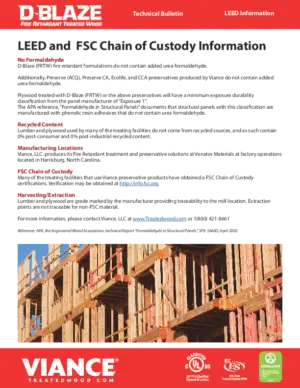
Additional information can be found below.
If you have any questions please feel free to contact me.
Thanks,
Todd Schoffstoll, Western Regional Manager
704.340.3376
-
Can a fire retardant be added to Ecolife and still be effective?
The Ecolife treatment does not impart fire retardancy properties to decking.

Unfortunately there isn’t a treatment on the market for both durability and fire retardancy.
A fire retardant coating will likely wear off over time because it is not pressure impregnated. In addition, building codes do not recognize sprayed-on or brushed-on coatings as code approved fire retardants for wood products; they only recognize formulations that are vacuum/pressure impregnated products.
Most pressure treated fire retardants are for interior use only, i.e. our D-Blaze fire retardant treated wood product. However, there are some exterior fire retardants available but they don’t increase the weathering, durability, or insect/fungal protection of wood so they are usually only used on naturally durable species of decking like Redwood and Western Red Cedar. The availability is somewhat limited so you would have to check with your local retailer on availability.
Thank you,
Todd Schoffstoll, Western Regional Manager
704.340.3376
-
What is the peel and stick product I use for this FRT application?
An architect in Alaska asked about a peel and stick product for this application:
We have a project where we will use FRT plywood as roof sheathing to attach asphalt shingles (IBC provision allows is use this building type we are designing to). This sheathing well be attached to galv. sheet metal "Z' framing to provide a ventilation pathway. below the sheathing. Our concern it corrosive action between the metal framing and the FRT plywood. I'm thinking about calling out a peel and stick membrane between the metal framing members and the sheathing. Is there a recognized product used for the purpose?
Answer:
There is a peel and stick membrane tape that we recommend for use between metal framing and D-Blaze FRT sheathing. Please see the link below.
https://www.lowes.com/pd/Vycor-Plus-4-in-x-33-ft-Rubberized-Asphalt-Roll-Flashing/3151853
If you have any additional questions please feel free to contact me.
Thanks,
Todd Schoffstoll, Western Regional Manager
704.340.3376
-
Clarifying the difference between interior and exterior FRTW
D-Blaze FRTW meets the interior fire retardant treated wood (FRTW) standard. This means that D-Blaze can only be exposed to limited weathering. Proper applications are roof and wall sheeting, structural wall framing, interior stair framing, interior blocking for walls, roofs, electrical and plumbing. FRTW must be covered with proper roofing materials, building wrap and siding material within 90 days of installation.
Interior FRTW Standard
ASTM E 84 or UL 723 - Flame Spread
This test measures the surface burning characteristics of a material under fire conditions and assigns a flame spread rating. The code requires the project has "a listed flame spread index of 25 or less and shows no evidence of significant progressive combustion when the test is continued for an additional 20-minute period." Smoke emissions are also measured and ratings assigned on a similar scale.
Exterior FRTW Standard
Exterior FRTW will be continuously exposed to the weather. Examples of use would be timbers for decks, decking dimensions for exterior decks, siding of the structure, exposed trim mouldings, etc.
ASTM D 2898 - Accelerated Weathering
Sometimes referred to as the "800-inch rain test," this test has two methods to simulate weathering. Method A subjects the materials to 12 one-week condition cycles of 96 hours of water exposure and 72 hours of drying at 140 degrees F, the equvalent of 800 inches of rainfall over 12 weeks. Method B subjects materials to 1,000 hours of 24-hour exposures featuring four hours of wetting, four hours of drying and eight hours of resting, with drying time at 150 degrees F with continuous UV exposure.
Jonathan Whitehead, Eastern Region Sales
704-493-0023
jwhitehead@viance.net
Check out Jonathan's bio here.
Meet our Experts
Dr. Kevin Archer
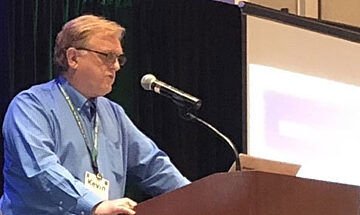
Director of Research and Development, has worked for CSI/Viance, LLC. since 1988 and was appointed Director of Research and Development in February 2013, responsible for Research Technology and Quality Control. Dr. Archer worked as the Director of Development with Viance from 2007 to 2013. Prior to joining Viance, he was an R&D Scientist at Chemical Specialties Inc. from 1988 to 1998 and worked as a Wood Preservation Mycologist for the New Zealand Forest Research Institute from 1986 to 1988.
Kevin has authored and co-authored numerous studies and most recently presented research on “DCOI - An Oil-borne Preservative System for Pressure Treatment of Poles, Posts and Sawn Cross Arms” at the International Conference on Overhead Lines in March 2019. Dr. Archer earned a Bachelor of Science in Botany, a Master of Science in Microbiology, and a PhD in Forestry.
Dr. Rufai Ibraham

Is a Senior Formulation Chemist with a history of working in biotechnology and the coatings industry. Dr. Ibrahim earned his doctorate in Philosophy (PhD) in Polymer Chemistry from the University of North Carolina at Chapel Hill. Dr. Ibrahim’s chemistry formulation experience includes development work with Syngenta and Sherwin Williams, with clinical pharmacology experience with Nuventra.
Dr. Ibrahim’s knowledge of formulation chemistry will expand our efforts in developing new chemistries for wood preservatives and fire retardant product formulations. Our continuing goal is to provide the wood preservation industry with environmentally advanced solutions for residential, commercial, industrial, and agricultural applications.
Ryan Sturdivant

Quality Control Laboratory Manager, joined Viance in 2010 as a Chemist/Research Associate. In his current role, Ryan is also Viance’s radiation safety and compliance officer. Previous to Viance, Ryan worked for Carillion Labs as a medical technologist and Appalachian State University as a research assistant.
Ryan earned his Master’s degree in Chemical Engineering from NC State University and his BS degree in Chemistry at Appalachian State University.
Steve Furr

Has been employed with CSI/Viance, LLC since 1988 and was appointed Director of Engineering and Technical Services in 2012. Steve began his career with Chemical Specialties in 1988 as an engineering assistant while still in college and became a full-time engineer after graduation in 1990. He worked in various positions including Plant Engineer, Plant Maintenance, Wood Treatment Engineer (working as a CSI engineer for WoodTec), and was promoted in 2012 to Engineering Manager in order to focus on customer treating facilities.
Steve attained a Bachelor of Science degree (Hons) in Mechanical Engineering with a minor in Mathematics from University of North Carolina at Charlotte.
Robert (Bob) Baeppler

Industrial Development Manager, has been with Viance since 2017. Bob has extensive experience in the wood industry. Bob previously worked as sales manager for Forest Products Research Laboratory, representing the company at the American Wood Protection Association (AWPA) and the American National Standards Institute. Bob was elected and served as president of the AWPA, 2017-2018.
Prior experience includes regional sales manager for McFarland Cascade (now Stella-Jones) and business manager for Chemonite products with Arch Wood Protection (now Arxada) and sales positions with T. R. Miller
Mill Company and Applied Research Group Inc. Previous to these positions, Bob served in management roles with International Paper Company as manager of technical services over the Treated Wood Products Division, TSO coordinator, pole yard supervisor, production specialist, acting plant manager, and treating supervisor. Bob earned his BS degree in Forest Industries at The Ohio State University in four years while also working full time.
Todd Schoffstoll

Western Regional Manager, has been with Viance since 2012, starting out in Technical Services and now responsible for business development in the Western US and Canada. Todd earned his MBA from the University of Phoenix and his BS in Forest Resources Management from the University of Washington.
Todd’s understanding of the technical aspects of wood, treated wood preservatives, treating plant operations and the customers’ needs makes him a valuable asset to both his customers and Viance.
Jonathan Whitehead

Eastern Region Sales and Business Development Manager for Viance, brings over 17 years of experience in the building materials industry. Jonathan served as domestic and international sales account manager for Cox Industries for the past 11 years with responsibility for all treated fire-retardant lumber sales. Prior to his role with Cox, Jonathan held the post of general manager for Builder’s First Source in Cashier’s, NC for six years.
A graduate of the University of Tennessee in Knoxville, Jonathan earned his Business and Political Science degrees after serving eight years as an infantry combat specialist with the US Marine Corps, where he earned two combat action medals and was promoted meritoriously during combat in Desert Storm.
Use the form below for any questions or email us at marketing@viance.net.
We will answer your questions as soon as possible.
Ask our Experts